I was talking to a fellow golfer the other day and he asked the question what he should practice the most on his driver or another part of the game. I asked him why he thought it was important to practice with his driver. He stated, so he could have more accuracy and keep the ball in the fairway to give him a chance to get to the green better.
I asked him how many drives do you hit in a round. He thought about it and stated 18. I explained to him that in reality you only hit 14 drives. He asked, what happened to the other 4 drives. I stated that those are par threes. Most par threes for average golfers are only 150 yards or shorter, therefore, you wouldn't hit a driver. He stated he never thought of that.
Then I got into percentages. I stated that the higher percentage of practice should be based the higher percentage of shots that will be taken in the course of a round of golf.
If par is 72 and you only hit 14 drives that is only 19% of your score. Even if you hit 18 drives that is still only 25% of your score. Putting is the highest percentage of your score in golf. In 18 holes of golf the par for putting is 36, which is 50% of your score. The remainder of your score after the tee shot is 25-31% depending on the number of drives you consider as 14 or 18. So what is your area you want to practice most, drives or putts.
With the information in previous paragraph, you want to spend most of your time on putting, then chipping and pitching and working on 150 yards in which will be at least 75% of your scoring. Then the remainder of the practice you want to work on is your swing technique, tempo and yardage control. The least amount of time should be spent on your driver.
In the mathematical scheme of things, Drives are the only constant in the game. You see, there only 14-18 holes to which you would probably hit your driver. So you will not hit less than 14 and no more than 14 shots with your driver (not including par threes). That is the only constant in the game. You cannot go up or down it stays 14. The rest of the game is what truly determines your score. If you had a 400 yard hole and you hit a 1 iron 200 yards that gives you 200 yards left and you hit the 1 iron again. You will either be on the green or close to the green depending on your accuracy. So you have to either chip close and one putt or two putt for a par. Any additional strokes is what makes your score add above par.
With all this being stated above it comes down to the game of golf is a mathematical percentage that determines how close your score will be to par. Mathematics determines what you need to work on and how you need to play the game. The old saying of 10% skill and 90% mental is truly not an understatement.
I know that is a lot of math, but, I just wanted to get the point across that golfers should spend most of their time putting, chipping, and working on 150 yards and less into the green.
The other practice should be on swing technique, tempo, and balance. Not smacking the driver over and over on the practice range.
Until next time, go to the range and practice area with a purpose and your score on the course will get better........

Showing posts with label counting drill. Show all posts
Showing posts with label counting drill. Show all posts
Monday, May 13, 2013

Thursday, April 4, 2013
Five Spring Time Drills to Improve your Golf Swing
Well the weather is starting to get a little nicer out as we get further into spring. The golf bug will be kicking in and everyone will want to skip work school and get on the course. You haven't played golf for a few months and you want to get back into it. Your swing isn't the same since the end of last year because of the cobwebs, stiffness, and lack of movement has crept in.
Remember, stretch before every workout.
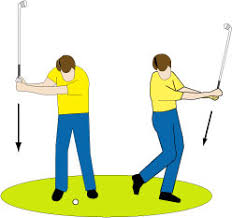 The release is one of the keys to a solid golf swing, in which
the wrists become un-cocked and turn at impact with the ball. If that does not
occur correctly, the club head will strike the ball at an angle, resulting in a
ball flight to the right or left.
The release is one of the keys to a solid golf swing, in which
the wrists become un-cocked and turn at impact with the ball. If that does not
occur correctly, the club head will strike the ball at an angle, resulting in a
ball flight to the right or left.
To perform this drill, take a club and swing about half your typical speed. Stop when your arms make a L during the backswing and check where your wrists are. Swing through and release, turning your wrists through the ball and finish by creating the reverse L as you follow through.
Continue swinging in this manner, but increase the speed. You will become more cognizant of these two important points in the golf swing while noticing increased power.
If the desired ball flight is not occurring while you're doing this drill, adjust your grip and arm angle. These should be slight adjustments that the individual golfer will need to experiment with, because it depends somewhat on the strength of the grip and velocity of the swing.
During the adjustments, continue to do the drill and test different arm angles and grips. This will help the golfer understand the relationship between club head, wrist motion, arm angle and grip in his own swing.
 the putting green. Attempt to hit each ball into the hole,
concentrating only on the length of your putting stroke. Every putt, no matter
the distance, should be struck with the same speed of the putter. The only
element that changes is the length of the backstroke. Continue to vary distances
while keeping the same pace, but altering the length of the backswing. The final
step is to do this drill with several balls and various distances with your eyes
closed. This will allow you to feel the clubhead move back and forth through the
ball.
the putting green. Attempt to hit each ball into the hole,
concentrating only on the length of your putting stroke. Every putt, no matter
the distance, should be struck with the same speed of the putter. The only
element that changes is the length of the backstroke. Continue to vary distances
while keeping the same pace, but altering the length of the backswing. The final
step is to do this drill with several balls and various distances with your eyes
closed. This will allow you to feel the clubhead move back and forth through the
ball.
Remember, stretch before every workout.
Stance
If you are having trouble with your aim, the ladder drill may help. To perform the drill, drop a ball in front of you and address it as if you
are lining up to take a swing with a mid-iron so your feet are neither open nor
closed to the target.
Drop the club at your feet so the shaft runs from foot to foot. Look down and examine where the club is pointing and make adjustments. Imagine the club making a line to out to the target. If that line is to the left of the target, during a real golf shot, your ball will end up to the left. If the club's line is to the right of the target, then your ball will fly to the right of the target.
To correct, aim slightly left or right of your starting point, depending on the direction of the error. For example, if the club line is pointing to the left, adjust your stance slightly to the right and repeat the drill.
Do this drill regularly and you will see a noticeable difference in how you address the ball.
Drop the club at your feet so the shaft runs from foot to foot. Look down and examine where the club is pointing and make adjustments. Imagine the club making a line to out to the target. If that line is to the left of the target, during a real golf shot, your ball will end up to the left. If the club's line is to the right of the target, then your ball will fly to the right of the target.
To correct, aim slightly left or right of your starting point, depending on the direction of the error. For example, if the club line is pointing to the left, adjust your stance slightly to the right and repeat the drill.
Do this drill regularly and you will see a noticeable difference in how you address the ball.
Follow-through Drill
To perform this drill, take a club and swing about half your typical speed. Stop when your arms make a L during the backswing and check where your wrists are. Swing through and release, turning your wrists through the ball and finish by creating the reverse L as you follow through.
Continue swinging in this manner, but increase the speed. You will become more cognizant of these two important points in the golf swing while noticing increased power.
If the desired ball flight is not occurring while you're doing this drill, adjust your grip and arm angle. These should be slight adjustments that the individual golfer will need to experiment with, because it depends somewhat on the strength of the grip and velocity of the swing.
During the adjustments, continue to do the drill and test different arm angles and grips. This will help the golfer understand the relationship between club head, wrist motion, arm angle and grip in his own swing.
Putting Drill
One of the least-practiced skills of golf is putting even though it is a huge part of the game. While being able to read greens is an
important element to being a good putter, the most critical part is
understanding pace. To perform this drill, place three balls at 5-feet intervals
away from the hole on
Counting Drill
Is a hook or slice killing your golf game?
Try this drill on for size. Take a normal backswing. At the top of the
backswing, stop. Count to 2 before proceeding back to the ball. This will
decrease the speed of your lower body and help you think of your swing in
sequential parts, exposing issues with your downswing and giving you the ability
to see, feel and correct them.
This drill will help the golfer expose an inconsistent velocity issue with his/her swing and body. If the body is slightly ahead or behind the golf swing, then the ball will be sliced or hooked. This drill will break this timing issue by making the golfer's body move at the same time as the club.
This drill will help the golfer expose an inconsistent velocity issue with his/her swing and body. If the body is slightly ahead or behind the golf swing, then the ball will be sliced or hooked. This drill will break this timing issue by making the golfer's body move at the same time as the club.
Penny Drill
This simple but extremely effective drill will help a golfer
get the ball off the ground quickly. Take a penny and place it on a practice
mat. Hit a penny off a mat. Try to hit the penny off the mat with different
clubs. See how high you can get it to fly. This will help you stop topping the
ball. Now try to hit the penny when a ball is on top of it. This will continue
to train you not to top the ball.
Well time to go. Keep practicing and the game will get easier.
bye for now.....
Subscribe to:
Posts (Atom)